Guide
Can Claude be your task manager?
Yes for capture, triage, and breakdown; no as a system of record, until you give it one. Claude is where tasks are born, because they surface mid-conversation. Pair it with a single Markdown checklist it can read and write, and it quietly becomes the best task manager you've used.

Every task manager has the same weak point: tasks don't appear inside it. They appear in conversations, and in 2026 an increasing share of those conversations are with Claude. "Also remind me to record the demo before Friday" gets typed into a chat, not into an app. So the real question isn't whether Claude can manage tasks; it's whether you can stop tasks from dying in the scrollback.
What Claude is genuinely good at
Three task-manager jobs, done better than any app: extraction (it watched the conversation, so it knows "check with Sarah" is a follow-up), breakdown (hand it a scary task and get five doable ones), and triage (ask what to do first and it reasons about your actual context instead of sorting by due date). What it lacks by default is the boring part: a durable, owned list.
The pattern: one file, project-grouped, dated
Give Claude a single Markdown file with checkboxes, grouped by project, newest first, every entry dated. Ask it to add tasks there during conversations and check them off when you say so. That's the whole system. It works because plain text is the one format that survives everything: it opens in any editor, commits to git, and moves between claude.ai, Claude Code, and whatever you're using in three years.
Where it falls apart without help
Two places. Consistency: freehand, Claude will format entries slightly differently each session, and your tidy file drifts. And friction: "please add a task to the file about the demo" is a sentence you'll stop typing by Thursday. Both are solved by making the pattern a skill with exact rules and a two-character command.
The one-command version
That skill is JotThread. /jot todo record the demo files the task under the right project. /jot done demo checks it off and archives it. /thread renders the whole file as a board in the chat:
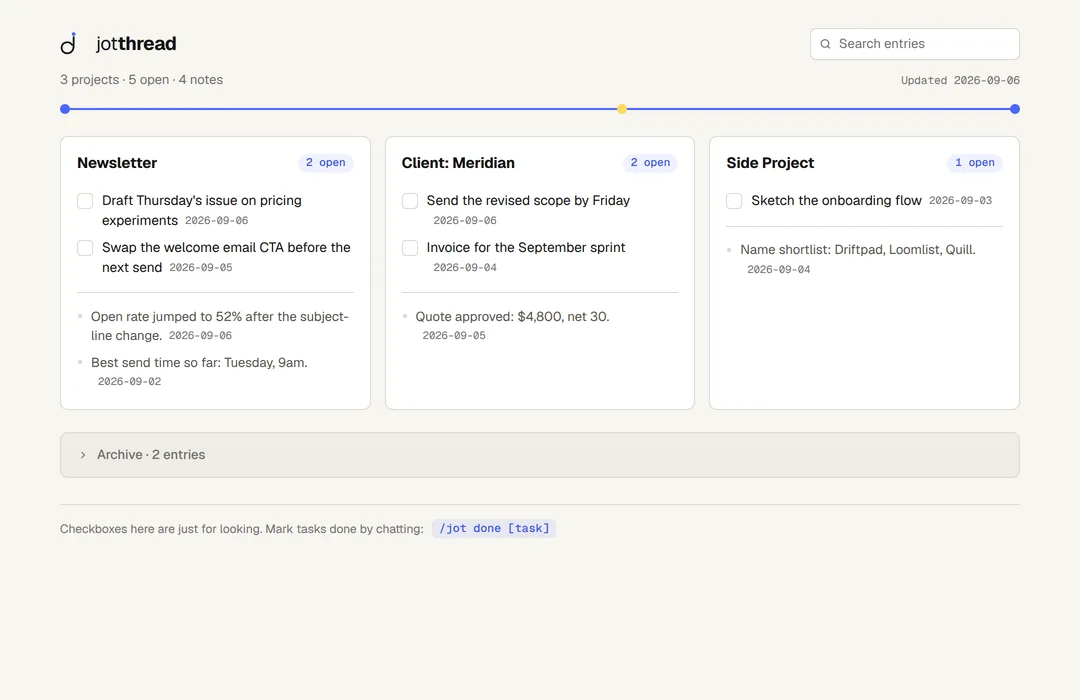
And because bare /jot extracts from the conversation itself, the "also remind me to..." sentences get caught where they happen. The wider capture workflow, including two free approaches, is in this guide.
Common questions
Can Claude replace Todoist or Things?
For conversation-born work, yes: capture, organization, and review all happen where the tasks appear. What Claude won't do is push notifications or scheduled reminders, so keep a calendar for time-critical items.
Does this work in Claude Code?
Especially well. The file lives in your repo, Claude reads and writes it in place, and you can commit your task list next to the code it refers to.
Why Markdown instead of an app?
Because a checklist you own outlives every app. Plain text opens anywhere, diffs cleanly, and never holds your tasks hostage to a subscription.
The one-command version.
/jot todo captures the task, /jot done checks it off, /thread shows the board. $29 once, and the list is a file you own.